


Aquaculture Water Tanks
Corrugated steel aquaculture tanks are a new type of aquaculture facility assembled from high-strength galvanized steel sheets formed by roll pressing. They feature high structural strength, strong corrosion resistance, and convenient installation. The main structure consists of corrugated steel sheets, connecting bolts, sealing strips, and a supporting piping system. Cylindrical containers with diameters of 3-15 meters and heights of 1.2-4.5 meters can be flexibly customized to meet aquaculture needs, with an effective volume of 5-500 cubic meters. They are suitable for aquaculture, recirculating aquaculture systems, and high-density intensive aquaculture scenarios.
Core Advantages of Galvanized Water Storage Tanks
High - Strength Compression Resistance
The thickness of galvanized steel plates usually ranges from 1.0 to 4.0 mm, with strong pressure - bearing capacity, making them suitable for high - water - level or underground installation.
Rust - Proof and Corrosion - Resistant
The hot - dip galvanized layer (with a zinc layer of ≥275 g/m²) provides long - term anti - rust protection. The service life is 10 - 20 years (regular maintenance is required in humid environments). It can also adapt to the common acidic and alkaline environments in farms (such as disinfectants and volatile gases from animal excrement).
Flexible Adaptability
They are assembled in a modular way, and the capacity can be customized (ranging from 3 to 2000 cubic meters). They support above - ground, semi - underground, or fully underground installation, saving space and adapting to complex terrains.
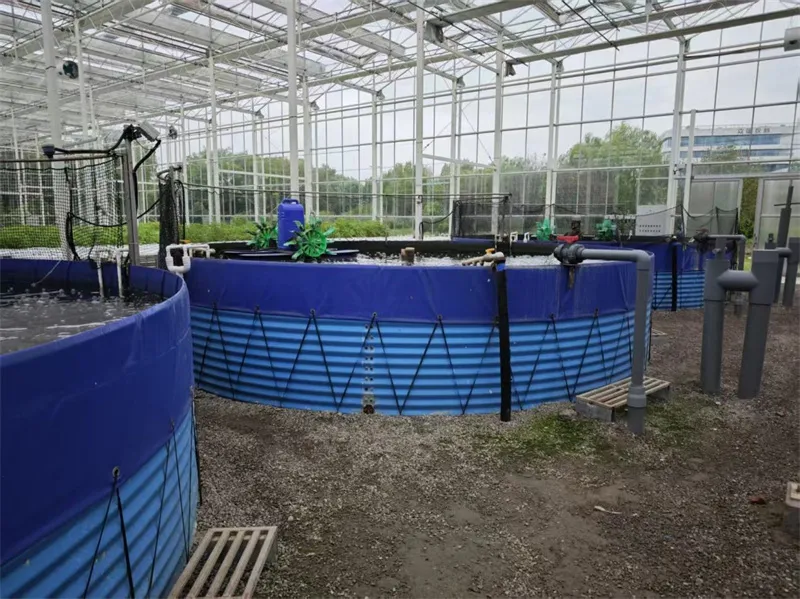
Structural and Design Key Points
Main Structure
- Material: Hot - dip galvanized steel plates. The joints are fixed with bolts and a PVC inner liner is used for waterproofing.
- Reinforcing Ribs: Vertical or horizontal reinforcing ribs are welded on the side walls to prevent deformation (especially when installed underground).
Anti - Seepage Treatment
- Inner Anti - Seepage Layer: A PVC anti - seepage membrane (0.5 - 1.2 mm) or a food - grade TPU coating is laid to eliminate the risk of leakage.
- Joint Sealing: Rubber gaskets are used for bolt holes, and polysulfide sealant is filled in the gaps between the plates.
Functional Accessories
- Water Inlet System: Connect to a water pump or rainwater pipe, and install a filter screen at the front end (to prevent leaves and sediment).
- Water Outlet System: A sewage discharge valve is installed at the bottom, and a water - level scale or electronic sensor is installed on the side wall.
- Protection Measures: A fall - prevention net or a light - duty ceiling is installed on the top to prevent animals from falling in or debris from contaminating.

Installation Process
Foundation Construction
Level and compact the ground, pour a concrete foundation (with a thickness of ≥15 cm), and embed anchor bolts. For underground installation, dig a foundation pit, lay a 10 - cm sand cushion layer at the bottom, and compact it.
Assembling the Tank Body
Assemble the galvanized steel plates layer by layer according to the design drawings. After tightening the bolts, apply sealant. Weld the reinforcing ribs (if required by the design) to ensure that the verticality deviation of the side wall is ≤2%.
Installing the Inner Anti - Seepage Layer
After laying the PVC membrane, heat - weld the joints and fix the edges at the flapped edge of the tank top. Conduct a 24 - hour water injection test. After checking for no leakage, it can be officially put into use.
Pipe Connection
Install the inlet pipe, outlet pipe, and overflow pipe. In cold regions, install insulation sleeves.
Application Scenarios and Precautions
1. Application Scenarios
- Livestock and Poultry Farming: Drinking water tanks for pig farms, cooling water tanks for chicken coops, and medicated bath tanks (with an anti - corrosion inner liner required).
- Aquaculture: Temporary culture ponds, circulating water regulating ponds (pay attention to the safety of the anti - rust coating).
- Arid Areas: Large - scale rainwater collection to ensure water supply for farms during the dry season.
2. Precautions
- Anti - Rust Maintenance: Check the wear of the zinc layer every year. For locally rusted areas, sand them and spray zinc - rich paint.
- Water Quality Safety: Before using a new tank, clean and disinfect it (such as soaking with potassium permanganate) to avoid excessive release of zinc ions.
- Frost - Protection Measures: In cold regions, empty the water storage tank in winter, or add a heating rod (estimate the power at 1 W/L).
Hot Tags: aquaculture water tanks, China aquaculture water tanks manufacturers, suppliers, factory, plastic cistern tank, Agricultural Water Storage Tank, rv waste holding tanks, black water storage tank, steel water storage tanks, ro water tank


